
Compliance and self-direction
And students who may benefit most from style exploration

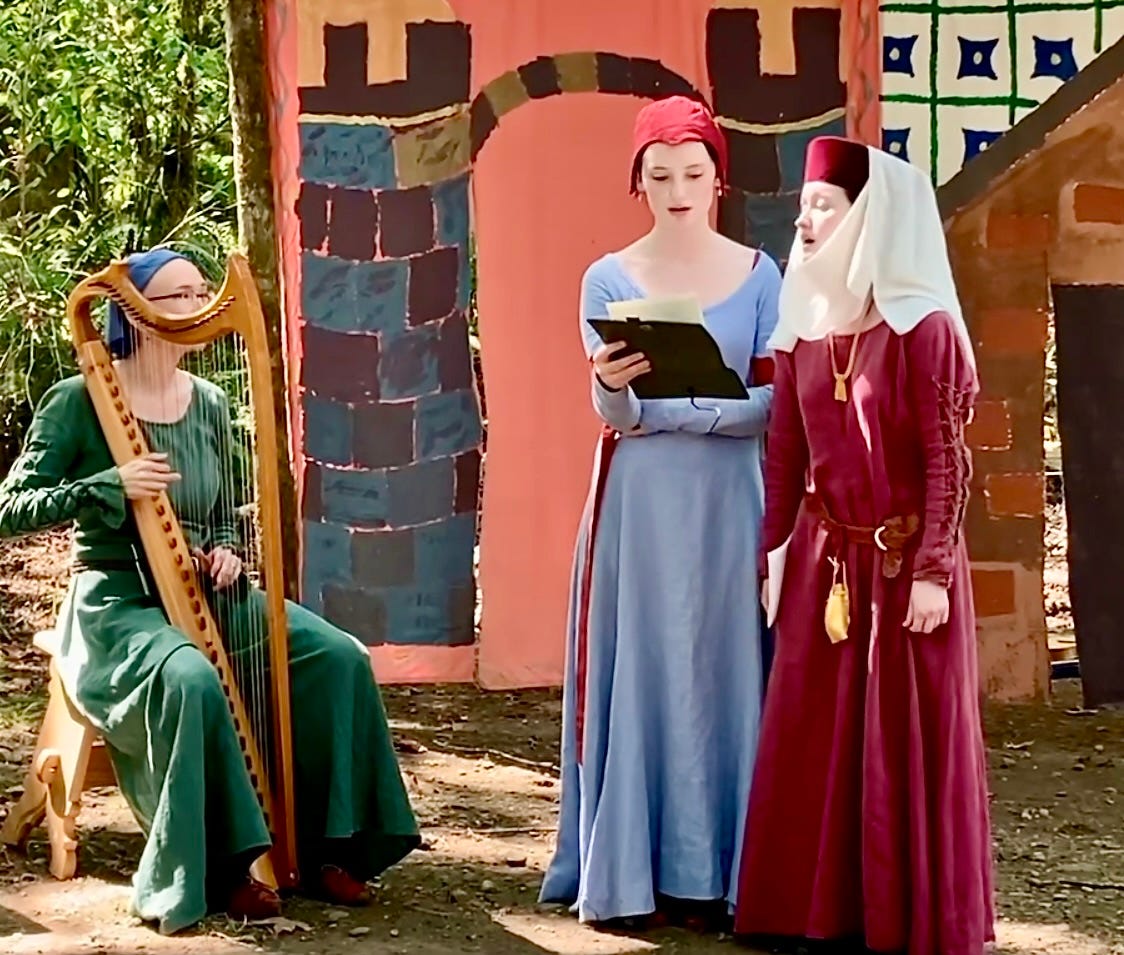
I was a pretty obedient child and a serious, diligent music student. In middle age, it’s been a surprise to find myself going more and more in the opposite direction: discovering the joys and rewards of dilettantish exploration. This past spring I took up the medieval harp as a total beginner, to accompany some young singers. What a delight to be new at something! It was a chance to experience some of the situations and feelings our students may go through.
Right away, in my enthusiastic daily practice, I found myself forging ahead to repertoire and techniques that I knew I wasn’t quite ready for. It was so much fun that I couldn’t say no to myself. Only when my left hand started hurting or I couldn’t make a string speak clearly would I turn back to the technical exercises I was supposed to have been doing. I did end up making a nice sound with a healthy hand shape. To actually become reliable at playing the repertoire I’d chosen, I would have had to work in a more focused way, with more metronome practice (…a lot more). For sure I experienced the limitations of my indulgent way of working. But I did make some progress. Had I forced myself to do it the right way, I don’t think I would have continued at all. I followed the way forward that was available to me at that moment in my life.
So maybe I’ve been picking up some tips from my less obedient students! I say that like a joke, but it’s not really a joke. I seem to have used up all my musical self-discipline a long time ago. I’m discovering, perhaps belatedly, how the energy to grow a skill can come instead from this other place. I find myself thinking in new ways about compliance and non-compliance, both in our student communities and inside ourselves.
Suzuki teacher Michele Horner wrote a book about her way of understanding the different learning personalities that music teachers encounter in our studios. She proposes seven types and encapsulates what might be the first-person mindset of each — one of which is, “Just tell me and I’ll do it.” That used to be me!, I thought when I read it, with the special thrill that comes with seeing something named accurately for the first time. As a child I found the workings of the world kind of mystifying. Though I couldn’t have articulated it, I longed for clearer rules to navigate by. When good teachers tried to lead me through a process of discovery, it often felt to me like they were just choosing to withhold crucial information. It was really kind of maddening. I wished they’d just tell me.
Most children and teens, most of the time, aren’t coming from a “just tell me” mindset. (I myself surely wasn’t like that all the time.) As teachers, we often wish we could just tell our students what we think they need to know and do. Occasionally what’s needed from us really is just the right piece of information at the right moment, but in general young students don’t learn best from us telling them things. The whole art of teaching individual lessons — the whole fun of it, when we’re doing it successfully — is in feeling our way, moment by moment with each particular student, towards the places where a path opens up for them to productively follow their own intelligence. Maybe this is part of what Shinichi Suzuki was getting at when he talked about children’s “life force.” I also think of D.W. Winnicott describing “the baby as a going concern.” Although we have to do a lot of things for young ones, Winnicott says, we don’t make them grow. That happens naturally, from within them. It’s a process we can trust.
Over the years I’ve often failed to trust the growth process of my less-compliant students. I’m talking about children who are happy to be in lessons and who seem to genuinely like us and want to play music, but aren’t necessarily interested in following our instructions. I remember the moment years ago when a mother explained at the start of a lesson that her daughter hadn’t practiced part of the assignment that week “because she didn’t know why she should.” At the time, I confess, I felt a little annoyed. (Why?! Because it’s what you come here and pay me for!) And I probably didn’t manage to answer the question in a way that felt satisfying for the child or the parent.
Fast-forward fifteen years, and that little skeptic is now getting a performance masters’ degree. As an adult she recalls multiple moments in her years of training when, to be ready to buy into the next level of instruction from her teachers, she first had to encounter some desirable piece of music that was too hard. She still needed to have a reason why. This process seems to be working out just fine for her! Not coincidentally, today she’s also an insightful, attuned teacher who knows how to connect with her students’ own motivations. If I missed some of the lessons I could’ve learned from working with her when she was my student, I’m getting a lucky second chance to pick them up from her as my colleague.
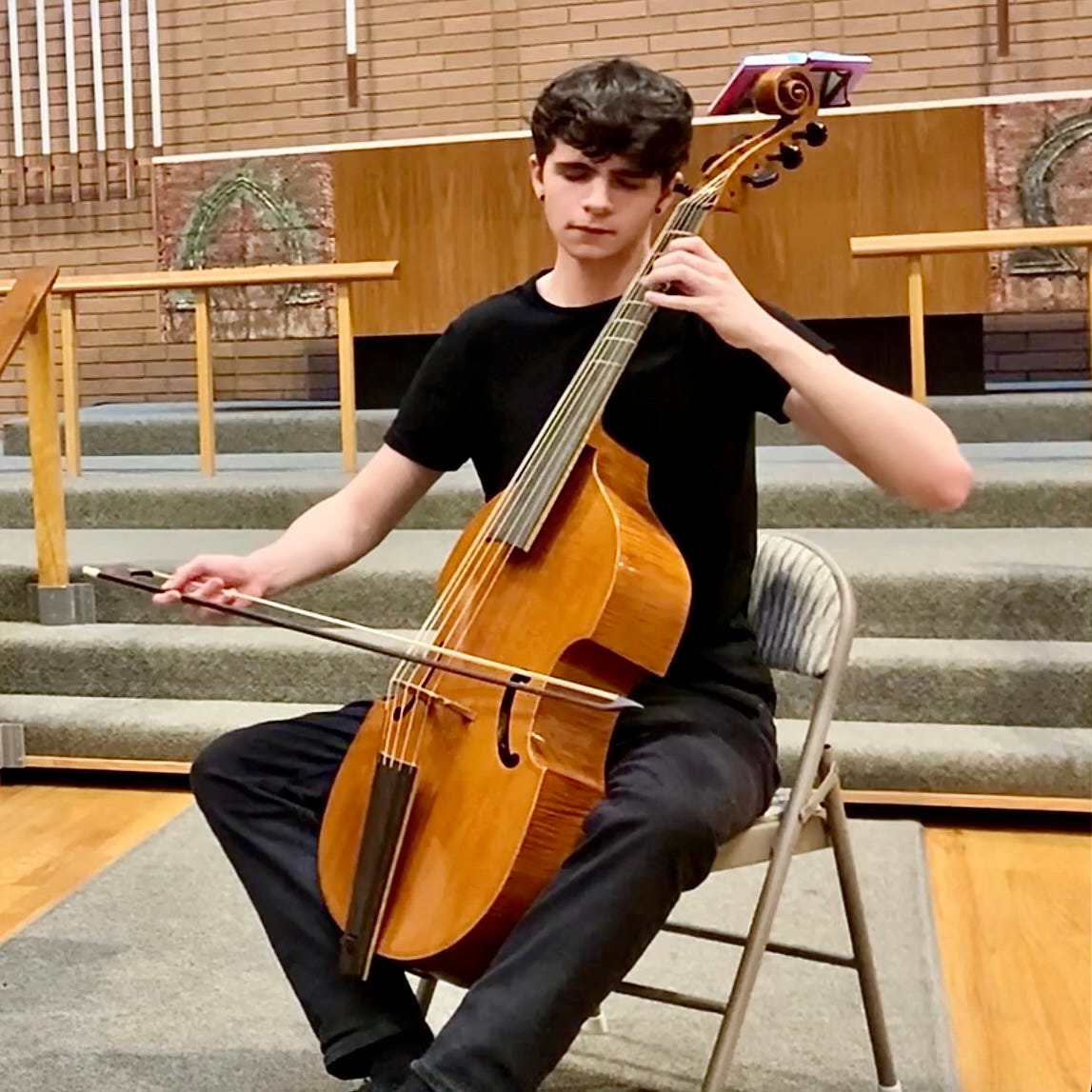
What does this topic have to do with my overall theme here in my newsletters about bringing underrepresented musical styles into the lives of young people? In my experience, students who need more autonomy and choice seem to be among the most likely to find a voice in traditional music or historical performance. They may feel enlivened by the chance to explore new things in the way I did recently with the harp, and also simply by doing something unusual. A student of mine switched from violin to viola da gamba a few years ago when he found a greater sense of freedom and DIY self-empowerment with it — both the physical instrument and its less-trodden pedagogical landscape.
Excerpt from “A Very Jenkins Tango” by Jesse Barnes (b. 2009), performed in May 2025 with the composer on viola da gamba, me on violin, and Juliane Büttner on piano
Although this student enjoys the historical repertoire that comes with the viol, he doesn’t want to be limited to it. In the spring he composed this ravishing tango. I can take no credit whatsoever; he honed his ear and his compositional skill in other areas of his musical life. But I was delighted and grateful that our lessons had turned out to be a hospitable space for him to follow some of his own ideas and desires. I didn’t yet know how to imagine that possibility in our initial violin years. I was focused on doing what I always did: trying in more and less creative ways to move a little kid through my agendas about beginner technique and practice habits. Having been through that rodeo many times, I feel confident saying that a great majority of students do seem to benefit from front-loading those foundational skills, even when it takes a lot of time and patience. But it’s clearer to me now that most doesn’t mean all, and that a student’s own ideas and direction might turn out to be more marvelous than anything I could have envisioned.
Our culture typically demands an enormous amount of compliance from young people, as they’re subjected to ever more ambitious achievement goals and allowed less and less free time to explore their own will. On the other hand, in a contradiction that I’m not the first person to notice, the heroes we hold up for children tend to be brave rule-breaking leaders. It’s hard to get these competing cultural ideals into some kind of balance. Not long ago I was filling in a recommendation form on behalf of a student applying to a highly competitive private high school, and all the prompts seemed to be about “leadership qualities.” Where were the questions about the virtues of cooperation and the essential skills of relationship? The mental image of a school community made entirely of leaders (who will they lead?) made me think of Garrison Keillor’s satirical Lake Wobegon, where “all the children are above average.” In sticking up for my rule-breaking students here, I don’t mean to romanticize non-compliance any more than the reverse. (And don’t get me started on “disruption” — or did that faddish term finally fade out over the last year as our public sphere began to experience disruption in spades?)
The truth is, we need innovators and iconoclasts, and we also need people who are good at the unsung labor of caring for the healthy structures and beautiful traditions that already exist. This is as true of our music studios as of any other community. I hope that over the years I’m getting better at welcoming a wider variety of learning personalities, whether the students meet my instructions with diligent compliance or with skepticism — which is a kind of diligence in itself: the diligence of inquiry.
We also need both compliance and non-compliance inside ourselves as individuals. If one was stronger than the other when we were kids, then hopefully as adults we’re developing the other side too. In our teaching, we need to be able to decide when to be in charge and when to trust a student’s own process. When we’re learners ourselves, it might be healthy now and then to do something our own way, disobediently, for the sake of our own pleasure and growth. And maybe those little moments give us courage for the larger acts of non-compliance with which we might build something new or, in some pivotal moment, defend the people and things that matter in our lives. Increasingly I find that I feel great appreciation for my less obedient students. They’re modeling some essential skills for the rest of us, not just about how to teach and play music but also about how to live.
- - -
With thanks to the former student who allowed me to write about a little bit of her story anonymously here, to Jesse Barnes (who now has a real viol-playing teacher!) for sharing his music and a glimpse of his path, and to Bill McJohn for lending me a medieval harp and for so generously and sensibly showing me what to do with it.
Like this post? Share it with someone!
🙌
https://open.substack.com/pub/leontsvasmansapiognosis/p/ethics-as-coherence-generation-not